Friday, 8 July 2016

Chinese FATS-C Squad WIP


I managed to drag myself away from the computer and do some painting, aided by my paint order having arrived.  Didn't realize I'd fluffed the first attempt at taking this focus stack until after processing the stack – that'll teach me I guess.

Still, looking on the positive side, I managed to put some paint down on my models, which has to count for something.

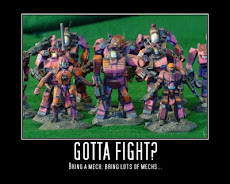
These are Heavy Gear Utopian & Eden faction Golems, which are described on the packaging as heavy augmented infantry.  I'm using these models, with small modifications made to them, to represent the Chinese all terrain suits from my novel Bad Dog.  I have another eight of them to assemble to make up a platoon, but I'm thinking have I got the selection of loadouts right?  I'm tempted to add an extra heavy gunner (second figure on the right) to each squad so as to have two per squad rather than one.

Still some more shading to do before I can do the fiddly stuff like decals etc, but one step closer to completion, and it was nice to remember how much I enjoy painting.
  

Friday, 1 July 2016

House Kurita: Work in Progress


My Kurita force is very much a work in progress, though the same could be said of all my battlemech forces, but I at least can field a lance or two for the other factions.  All of these have had some modifications made to them, ranging from quite minor to more ambitious work (some have commented that it takes guts to cut apart classic Unseens and repose them, but to me they're just my mechs).

The mechs above are missing a Phoenix Hawk and Archer, which I have not yet finished assembling , and my plan is to have three lances of four mechs with the Wasps and Stingers from the picture below to make up a traditional twelve mech company.


I haven't managed to put the base-coat of yellow on all of these, but the WW1 inspired jigsaw pattern camo scheme seems to look OK on the four light mechs I started working on.  I have  Phoenix Hawk LAM to assemble too.  My thoughts at the moment are that the LAMs will make a long range reconnaissance lance, and in addition I have a resin MAC Monster to assemble to finish my House Kurita force.

As per my current photography practice both of these pictures are focus stacks from twenty-five individual pictures using my 14-42 zoom (ISO 200, F8 at 1/6th of a second).
  

Monday, 13 June 2016

Megapixels

Micro four thirds 12 versus 16 megapixels showing same pixel area.

Not all pixels are equal. I say this, because it's true, if little understood by the non-photography enthusiast.  

Understanding why all pixels are not equal is relatively easy explain but, and it's a big but, the explanation requires the willingness to come to grip with things like F-stops and ISO numbers.

F-stops are an abbreviation for the ratio between the focal length (the F in F-stop) of the lens and the size of the aperture, and the corollary that one has to have larger lenses for larger sensors.  

The F-stop numbers are actually shorthand for one over the number, so F2 is a bigger aperture than F16 because a 1/2th is bigger than a 1/16th. Therefore the F-stop describes the size of the aperture that governs the amount of light that passes through the lens onto the sensor. The squiggly math can be found here.

The thing to takeaway is that the more light you let through the lens the better, and bigger lenses let through more light, but everything has a price, which is that the lens becomes physically larger.

Then there is the sensitivity of the sensor, which is described using what is called an ISO number.  

The three letter abbreviation comes from the International Organization for Standardization, see here. In short, it's a measure of how well the sensor reacts to light and it tells you how sensitive the sensor is. 

But, the higher the number used comes at a cost in image quality – usually noticeable as visual artifacts when there's not enough light to resolve the image being taken. Ideally what one is looking for is a sensor with a low number like 100 ISO that has a large range that goes up into the thousands.

However, all of the above is relative to the sensor size and the number of pixels it has.  

So it should be obvious that a big sensor with the same number of pixels as a smaller sensor means that the pixels are not the same size, and worse still, the amount of light gathered by the lens falling on said sensor is not the same either (if that doesn't make sense – remember that big lenses let through more light through them).

The difference in the ability of a large lens versus a small results in some thing that's called equivalence.  

A large frame, 35mm film equivalent film camera, that has an F2 lens will be letting in two stops more light than a micro four thirds camera (equivalent to a half frame from a 35mm film camera) fitted with an F2 lens; or if you prefer the micro four thirds camera's F2 lens is equivalent to a full frame lens at F4.

That's probably confused you unless you're already savvy with cameras and lighting. So what does this all mean for the non-enthusiast user?

Here's a handy-dandy table to confuse matters by over loading you with lots of numbers.

Click to see larger picture.

TL;DR:  The size of the aperture in relation to the size of the sensor matters.

So, if you're using your camera phone, which, because it has a small sensor (the smallest frame size in the illustration above), and because a small lens effectively provides a wide angle of view, it will be easier therefore to take pictures of small objects and have more in focus.  

But, despite whatever the it says about the number of megapixels, because the sensor is so small, you'll be unable to produce high quality big pictures, which may not be a problem if all you do is post to the web.
 
Here's a simple illustration that compares the size of the sensor of a full-frame camera down to a smart-phone.  Here you can see the big difference there is is sensor size.


Now what this means, bottom line if you like, is that light is everything when it comes to taking pictures.  

Also, bigger cameras capture more light, and don't be sucked into the more megapixels is better, if all things are equal, the size of the pixel really does matter when it comes to quality of your pictures.  This is what drives the image quality, which is also called picture noise comes. These are the artifacts or blurring you see when you enlarge a picture, which can be understood if you remember noise is defined by the ISO number of the camera.

TL:DR:  Lots of megapixels on a small sensor are not as good as less megapixels on a larger sensor because bigger pixels are better.

Saturday, 4 June 2016

Star Wars X-Wing: The Big Battle


Not your standard tournament game.

Last weekend we went to Brighton to see my Godson, his sister and my dear friends who are their lovely parents.  I, now having a job, was able to fulfill my Godmother role of providing Xmas and birthday presents for both the kids.  Being that they're Star Wars fans, and having got them both the old Star Wars X-Wing core sets a year or so ago, it seemed like a good idea to get them the new core sets as their late Xmas presents and having talked to both of them I had a fair idea of what ships they liked.

So Dylan got an A- and B-wing, the B-wing being his favourite fighter, and Chloe got a TIE Interceptor and Tie Advanced aka Darth Vader's fighter.

It's tricky manoeuvering your fighters when the table is this full.

Then they got to unpack everything and we ended up with sixteen ships on the table: six Rebel Alliance and Resistance fighters versus ten Imperial and First Order ships.  No attempt was made to balance the forces using the points system, all we did was not have any cards in play.  So all the fighters were pretty vanilla, and you know what, it was one of the best games of X-wing I have had the pleasure of playing.

I was the Mistress of the TIE fighter formation flying team.

Final outcome was a win for the Rebels/Resistance who only had to fly off the other-side of the table from where they entered, but the Imperials destroyed the fleeing B-wing.

On reflection, should have made the B-wing something the Rebels/Resistance had to protect, as it would have made for a more balanced game.  But apart from that the rules were up to the job of running a game without it becoming a slog or slowing down, though adding cards might have slowed down the turns, depending on what was chosen.

Fun was had.
PS: a link to a cartoon that says it all.
  

Monday, 30 May 2016

Star Wars Imperial Squadrons


As any wargamer will tell you, you need two forces for a wargame.  When you buy Star Wars X-wing one gets two TIE fighters to challenge the Rebel X-wing.  I haven't managed to maintain that Imperial disparity, primarily because my interest is in the Rebel Alliance ships, and because money.


Still I plan to add to my collection of Imperial ships because it's nice to be able to make changes in force composition.  Besides which it makes sense to have pairs of ships so that one can have a wingman.  Except for big ships like the Punisher above, or Slave 1 etc.

One of the things where Star Wars X-wing falls short is the ability to re-enact specific moves from some of the movies: for example Darth Vader and his two wingmen in the Death Star trench.  Now this isn't necessarily a bad thing, after all this is a game not a replay of a film, but I suppose I would like to have seen a rule that made a nod to this.  Something along the lines that Darth Vader's special ability is to have two junior pilots move when he moves – because at the moment, given the rules about movement order, Vader always moves last and shoots first for the Imperials.

More X-wing to come, as I'm writing up a battle report from a game I played this weekend.  Expect it later this week.
   

Thursday, 26 May 2016

Star Wars Rebel Squadrons


My collection of Star Wars miniatures has been growing slowly mostly down to me being broke.  However, now I'm working I feel I can treat myself to adding to my force because why have one of something when two is better and three or more is better still.  This probably counts as a wargamers mantra, along with oh look shiny!

Besides, this is a game I actually get to play, so I have actual motivation to keep adding to my force.  Though my recent X-wing purchases have been for my Godson and his sister who are both big Star Wars fans and who enjoy playing the game when I go and visit them.  We fly around the board making pew-pew noises and complaining about Dodgey Luke getting all the luck.

Anyway, my plan is get another two more X-wings and then re-touch the paint to make them look like the six main Red squadron craft at the Battle of Yavin.  I have compiled shots of the studio models and will do just enough re-touching to hint at each of the named pilots.


While we don't see A- and B-wings in the original film they are, I believe, canonically supposed to have been there, just off screen, lurking or something.

The Y-wings are of course for my Gold squadron.  Again some minor paint changes will be made to make them look more like what we see on screen.  It took me forever to realize that the markings on the top of the cockpit meant: one stripe for Gold Two and two stripes for Gold Three – dividing the band into two and three stripes and the Y-wing without a stripe was Gold leader.

At some future point, when finances allow, the Fantasy Flight Games Rebel Aces set with the different paint schemes for the A-wing and B-wing will be acquired.